

You can have bad EBITDA and still lead a strong board conversation.
But only if the story holds.
Most finance teams think the board story problem is:
“Write a better narrative.”
It isn’t.
The real problem is that teams try to generate a story without the context that makes a story credible. AI makes this obvious very quickly.
Because AI will always give you an answer even when it doesn’t have enough information to give you a correct one.
And in finance, an answer without context is worse than no answer.
That’s why I built a Board Storyline Generator.
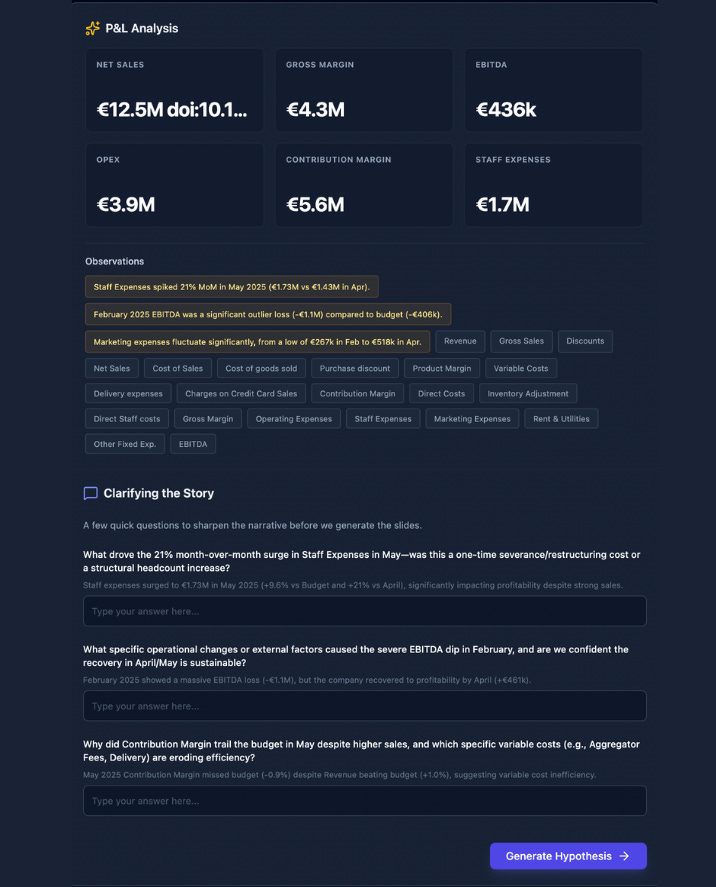
An AI app you can use instantly to work the way CFOs and FP&A actually build board stories:
In today’s letter you’ll learn:
Why a good board story is built on context.
3 steps to build a financial story.
How the Board Storyline Generator App works (you can try it)
Let’s begin.
A Good Board Story is Built On Context
Before AI, no one wrote board stories.
The CFO talked to FP&A.
FP&A already knew the context:
How This Company Frames Board Decks
What Was Debated Last Meeting
Which Assumptions Are Sensitive
What The Board Does Not Want Re-Explained
The CFO didn’t explain everything.
They gave direction:
“This quarter is about margin pressure.”
“The board will push on this assumption.”
“We already covered this last meeting.”
FP&A filled in the rest because they shared the same context.
That shared context is the story.
3 Steps To Build a Financial Story
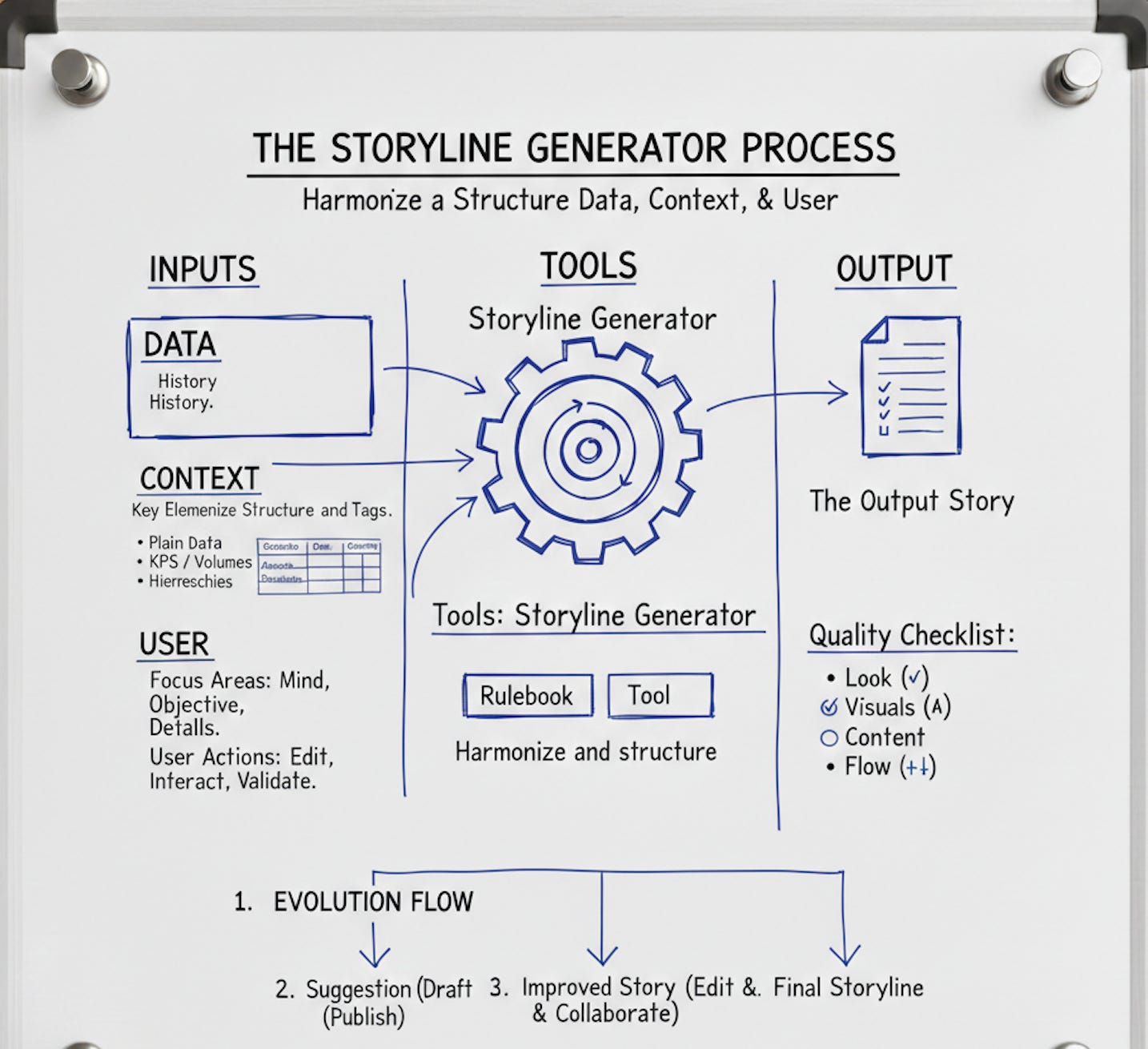
Never start with AI without context.
If you upload only numbers and ask for a story.
AI will only summarize and explain variances.
But it doesn’t know:
What decisions are already made.
What assumptions matter.
What the board expects next/
So the output collapses under scrutiny.
AI that doesn’t ask the questions isn’t useful.
Juts like a good FP&A manager doesn’t start with slides.
They start with questions. AI must do the same.
The minimum set of high-leverage questions that establish context.
That is the real shift. To build a board story with AI, you must combine:
Data
Context
User Objective
So here are 3 steps to build a good board story with AI.
Step 1: Prepare the inputs (and let AI ask)
A good story rests on 3 pillars.
If one is missing, the story becomes unsafe.
1. Aggregate the data
AI needs a full quantitative foundation:
History Past performance to detect trends
Plain Data The raw facts
KPIs And Volumes The real business drivers
Hierarchies Entities, accounts, regions, cost centers
2. Build the context
Numbers alone don’t explain anything.
Context must be structured:
Scenario What situation are we in
Date What period actually matters
Context What changed and why
This is where AI should ask questions, not generate text.
3. Define your purpose
Every board story is goal-driven:
Mind The mindset for this meeting
Objective What decision is required
Details How deep the board will go
Action What must be editable, interactive, and validated
This is the step most finance people skip.
They give AI numbers and expect judgment.
Judgment only appears after questions.
Step 2: Structure your data
Once inputs exist, they must be reconciled.
This phase is cyclical, not linear.
Engine A loop mixing data, context, and intent
Rulebook What gets included and what gets cut
Tools Structures that enforce consistency
Goal One coherent storyline
This is exactly what strong FP&A does with a CFO.
AI can do it too… if the system forces it to reason, not just write.
Step 3: The output
A board story is not a draft.
It’s a claim.
Before it’s shared, it must pass checks:
Look Board-ready formatting
Visuals Charts that clarify decisions
Content Accurate and relevant
Flow A logical narrative arc
Then it evolves:
Suggestion First structured storyline
Improved story Iteration driven by questions
Final storyline Board-ready output
This is how humans work.
And this is how AI must work.
Bu you can’t solve a context problem with a prompt.
You need a system that:
Stores context.
Remembers past decisions.
Asks the right questions.
Connects actuals, budget, and forecast
That’s why we built a Board Storyline Generator.
The Board Storyline Generator App
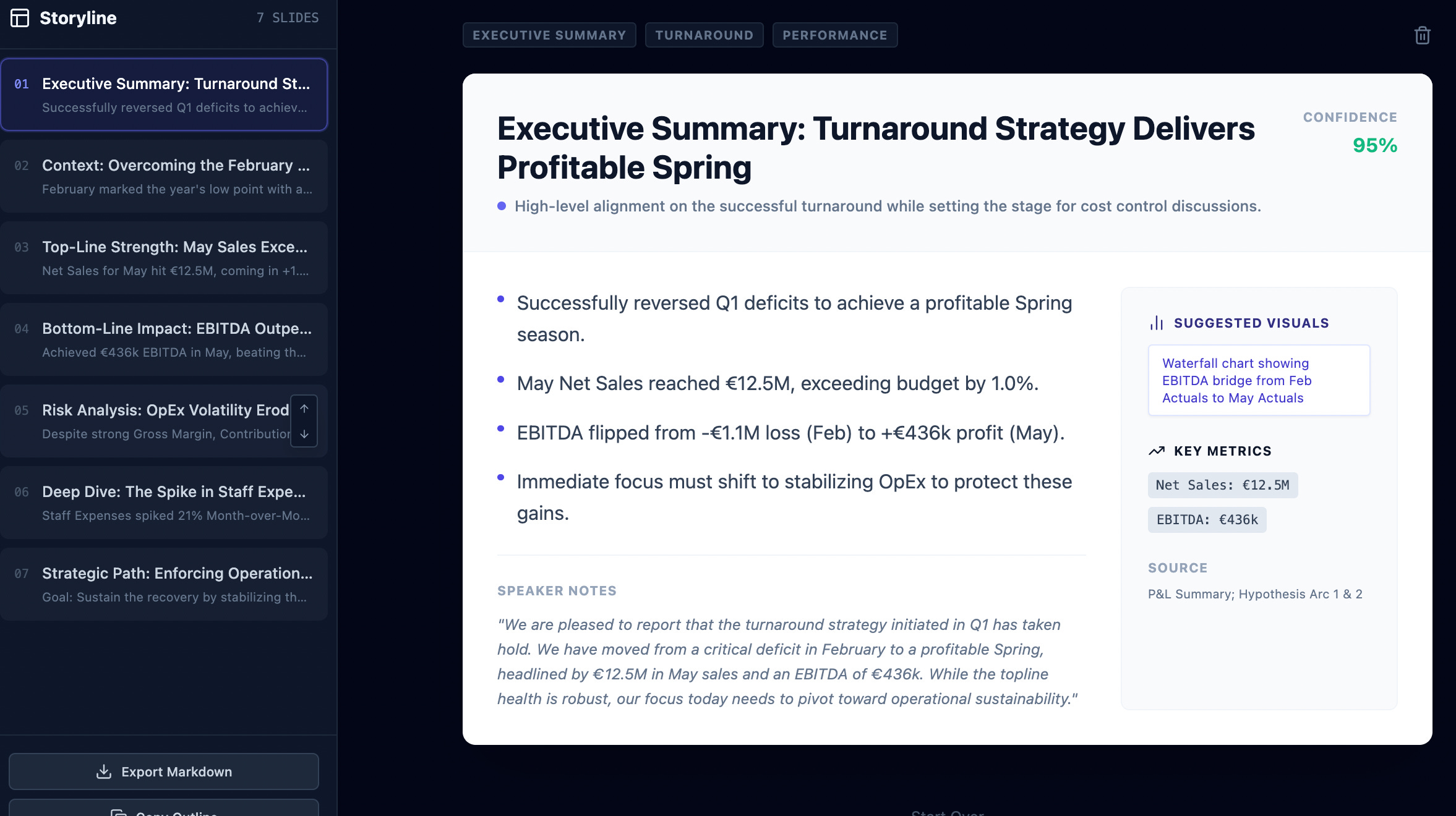
It mirrors the CFO and FP&A workflow, digitally.
It lets you:
Load your financials.
Capture board context.
Store business drivers.
Define narrative direction.
Then AI uses that context to:
Draft the storyline.
Ask the right questions.
Explain what changed and why.
Connect actuals, budget, and forecast.
Prepare you for the next board question.
So this isn’t just a chatbot that pleases you.
It runs multiple analysis and context layers. It uses real AI compute.
That’s why I’m putting this behind paywall.