

What a board story must look like with AI
Here is the Born2Cycle September 2026 Board Story.
Born2Cycle is a fictional bicycle retailer, finstory’s demo company, but the story runs on a full set of books: P&L, channels, cash, inventory, KPIs, and forecast.
Look at how it opens.
Source: finstory.ai Born2Cycle September story
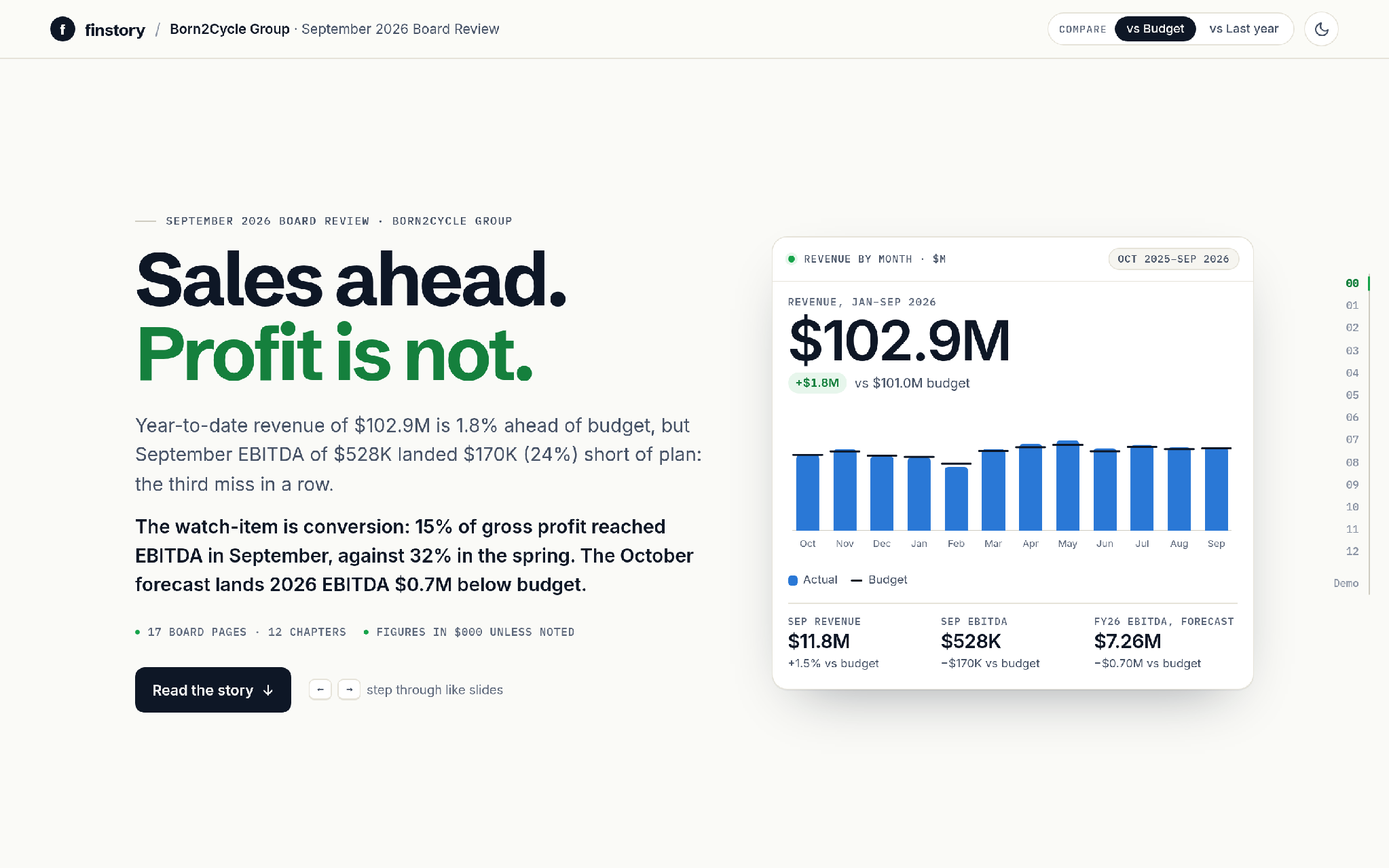
“Sales ahead. Profit is not.”
Year-to-date revenue of $102.9M is 1.8% ahead of budget, but September EBITDA of $528K landed $170K (24%) short of plan: the third miss in a row. Then the watch-item: only 15% of gross profit reached EBITDA in September, against 32% in the spring.
A board member who reads nothing else already knows the state of the business. That’s the test.
Then the story does three things most packs don’t.
Every variance carries its reason.
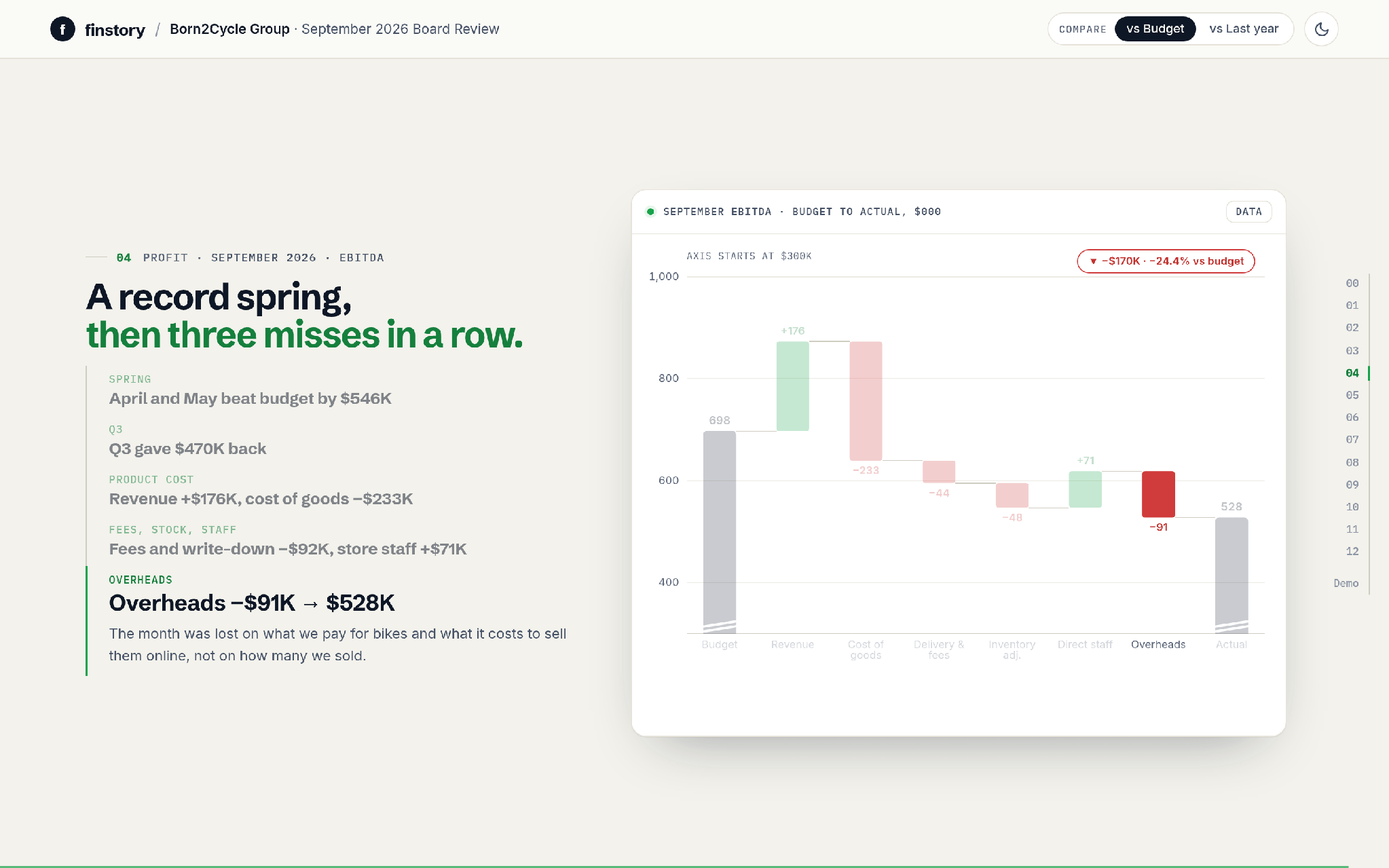
The EBITDA bridge walks from a $698K budget to $528K actual.
Revenue added $176K. Cost of goods took $233K back, because frames shipped after the August tariff step-up landed about 4% pricier. The marketplace raised its referral fee for bicycles from 8% to 12% in August, and prices there hadn’t followed.
Overheads added $91K: retained seasonal staff, a pricing study, and old and new ERP licenses running in parallel.
Source: finstory.ai Born2Cycle September story
Then one line that does the CFO’s real job:
“The month was lost on what we pay for bikes and what it costs to sell them online, not on how many we sold.”
That is the sentence your board remembers.
It ends with a decision, not a summary.
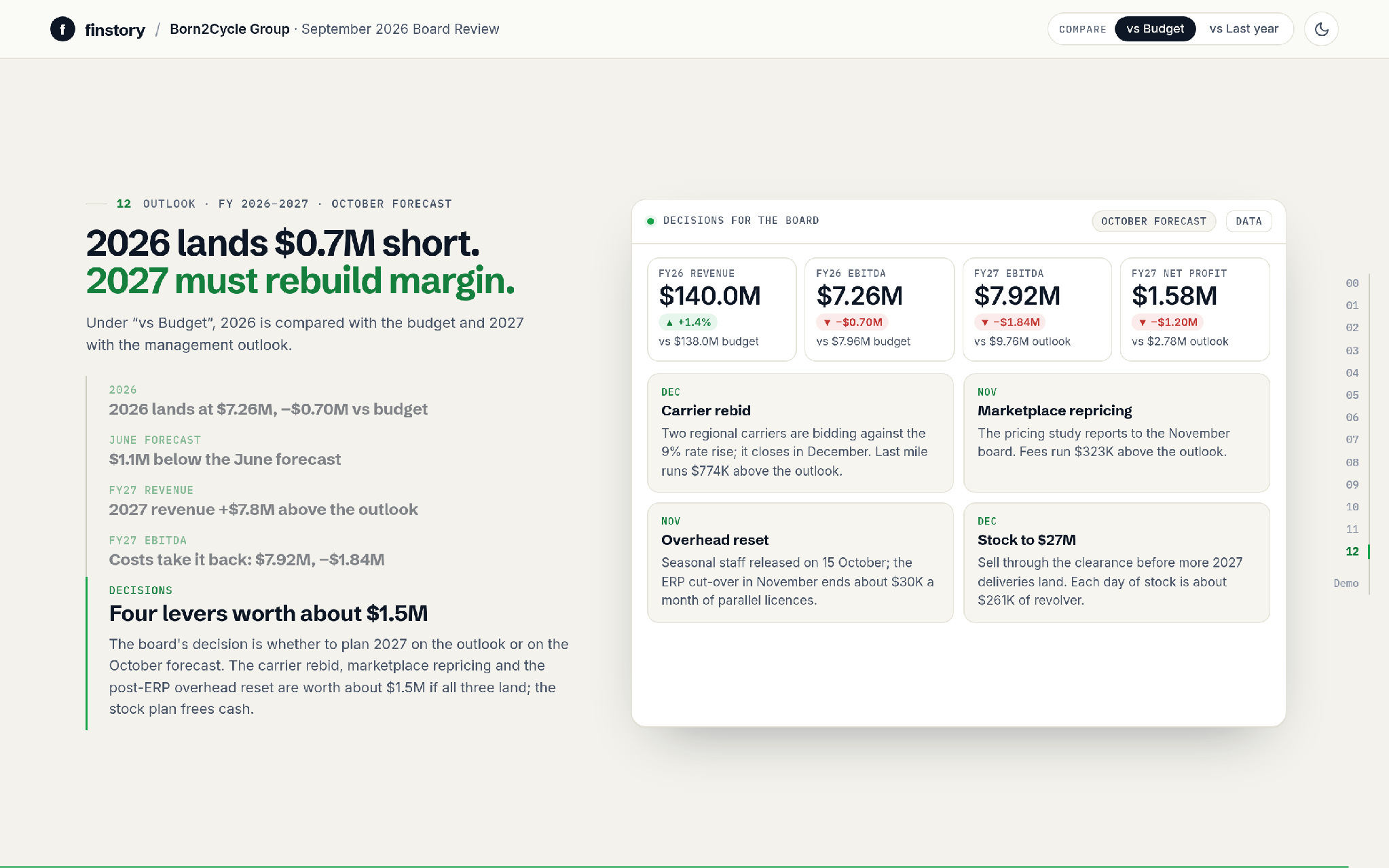
The October forecast lands 2026 EBITDA at $7.26M, $0.70M below budget, and 2027 EBITDA at $7.92M, $1.84M below management’s outlook. So the story asks the board one question: plan 2027 on the outlook or on the October forecast?
It lays out the levers next to it: a carrier rebid, marketplace repricing, a post-ERP overhead reset, and a stock plan to bring inventory to $27M. The first three are worth about $1.5M if all land.
Source: finstory.ai Born2Cycle September story
Notice what’s missing.
No adjectives like “strong” or “challenging.”
No hiding the miss on slide 30.
The bad news is in the headline, with its causes and a plan.
Board pack vs. board story
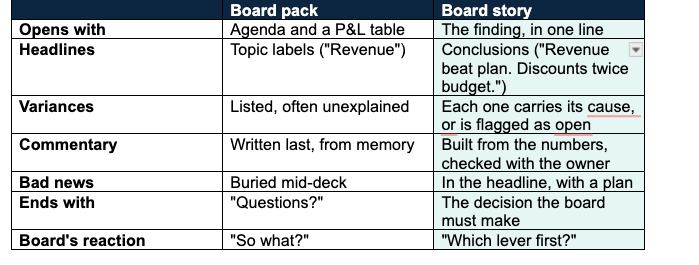
The board story framework
Use this structure for your next month.
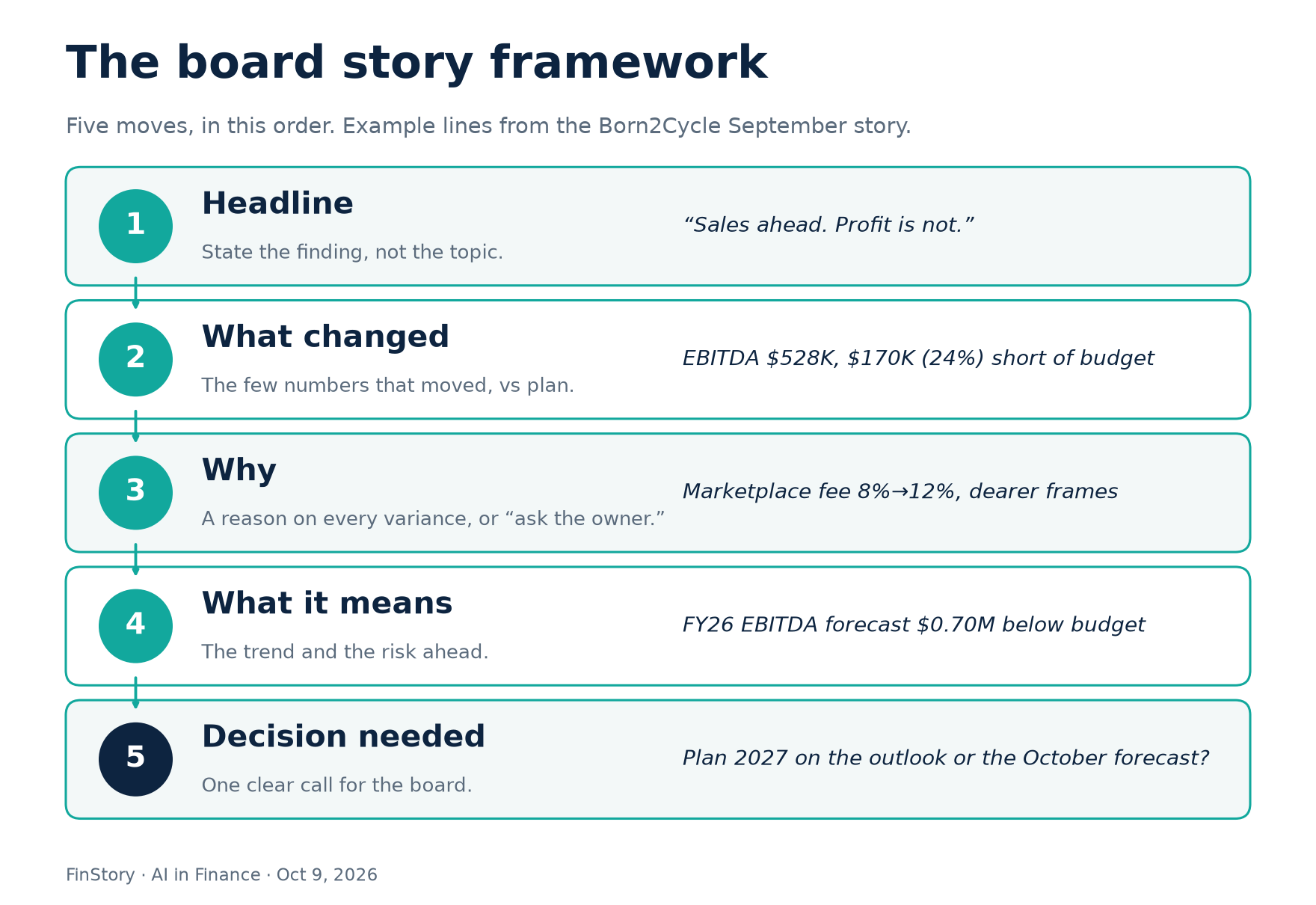
1. Headline: State the finding, not the topic. If your headline could appear in any month, rewrite it.
2. What changed: Three to five numbers that moved, against budget or last year. Not twenty.
3. Why: One cause per variance, with its size. If you don’t know, write “open: [owner] checking.”
4. What it means: The trend and the risk. Is this one-off or the new run rate? Born2Cycle tags about $150K of September markdown as one-off. That one phrase saves ten minutes of debate.
5. Decision needed: One clear question for the board, with the options and what each is worth.
The Bottom Line
The CFO’s job was never to produce slides.
It was to tell the board the truth about the business, early enough to act. AI is taking the assembly off your desk. Use that time for the part only you can do: the judgment.
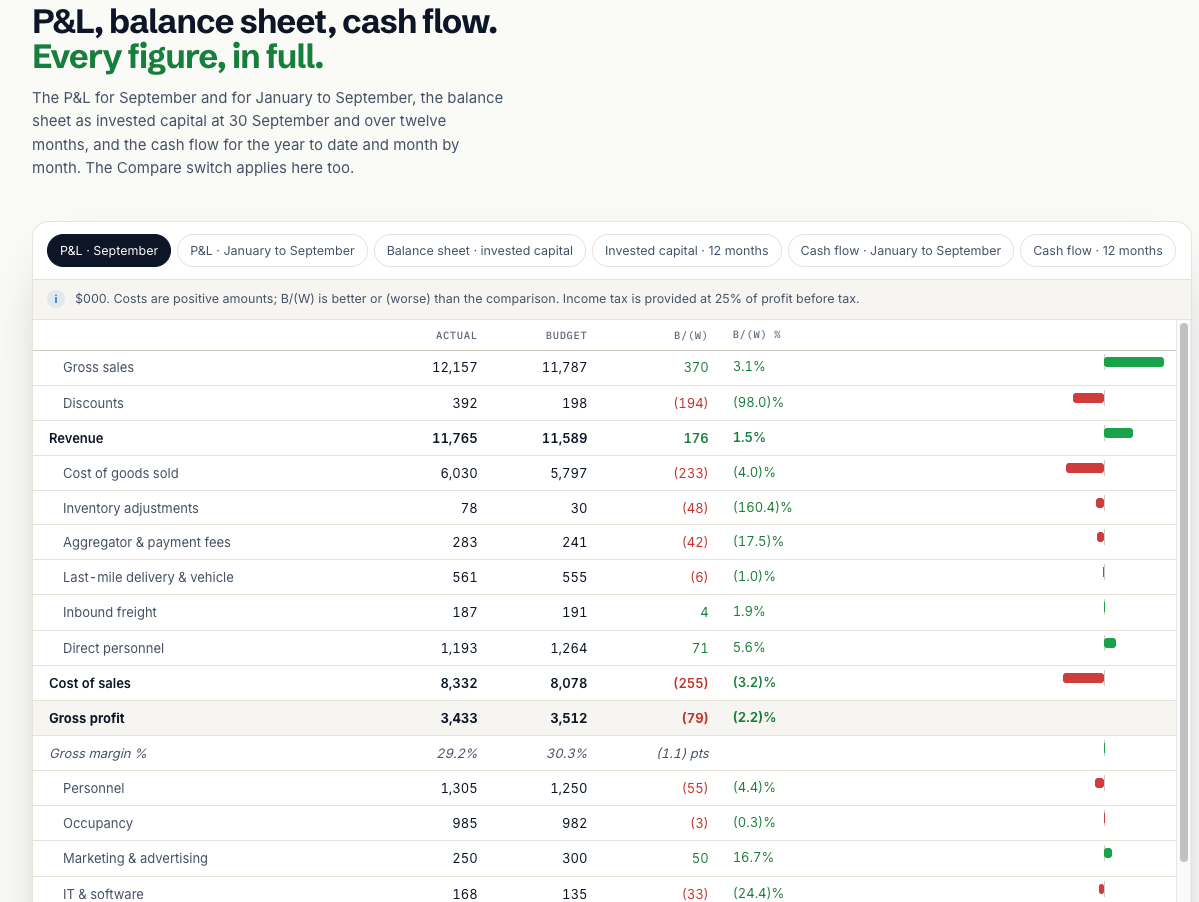
If you want to see how a full month reads this way, open the Born2Cycle September story and step through it like slides.
And if you want to see your own close told this way, you can try finstory.
Hit reply and tell me: what’s the one question your board always asks that your pack never answers? We read every response.
Team at finstory
AI-native platform that turns financial data into board-ready stories.
Find us on LinkedIn | finstory.ai

I don’t even know what this is